Horizontal Scaling
Weaviate can be scaled horizontally by being run on a set of multiple nodes in a cluster. This section lays out various ways in which Weaviate can be scaled, as well as factors to consider while scaling, and Weaviate's architecture in relation to horizontal scaling.
Basic concepts
Section titled “Basic concepts”Shards
Section titled “Shards”A collection in Weaviate comprises of one or more "shards", which are the basic units of data storage and retrieval. A shard will contain its own vector index, inverted indexes, and object store. Each shard can be hosted on a different node, allowing for distributed data storage and processing.
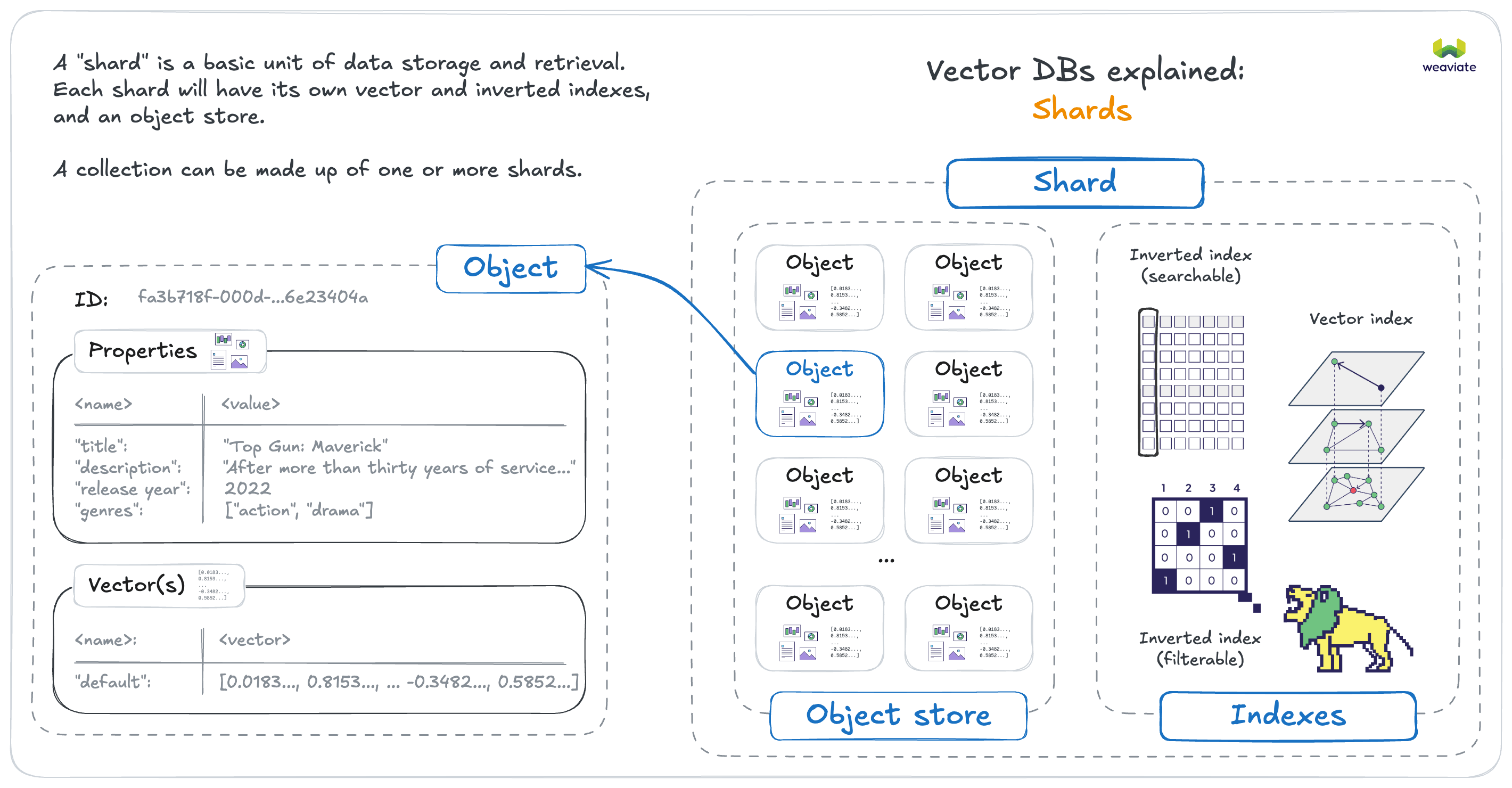
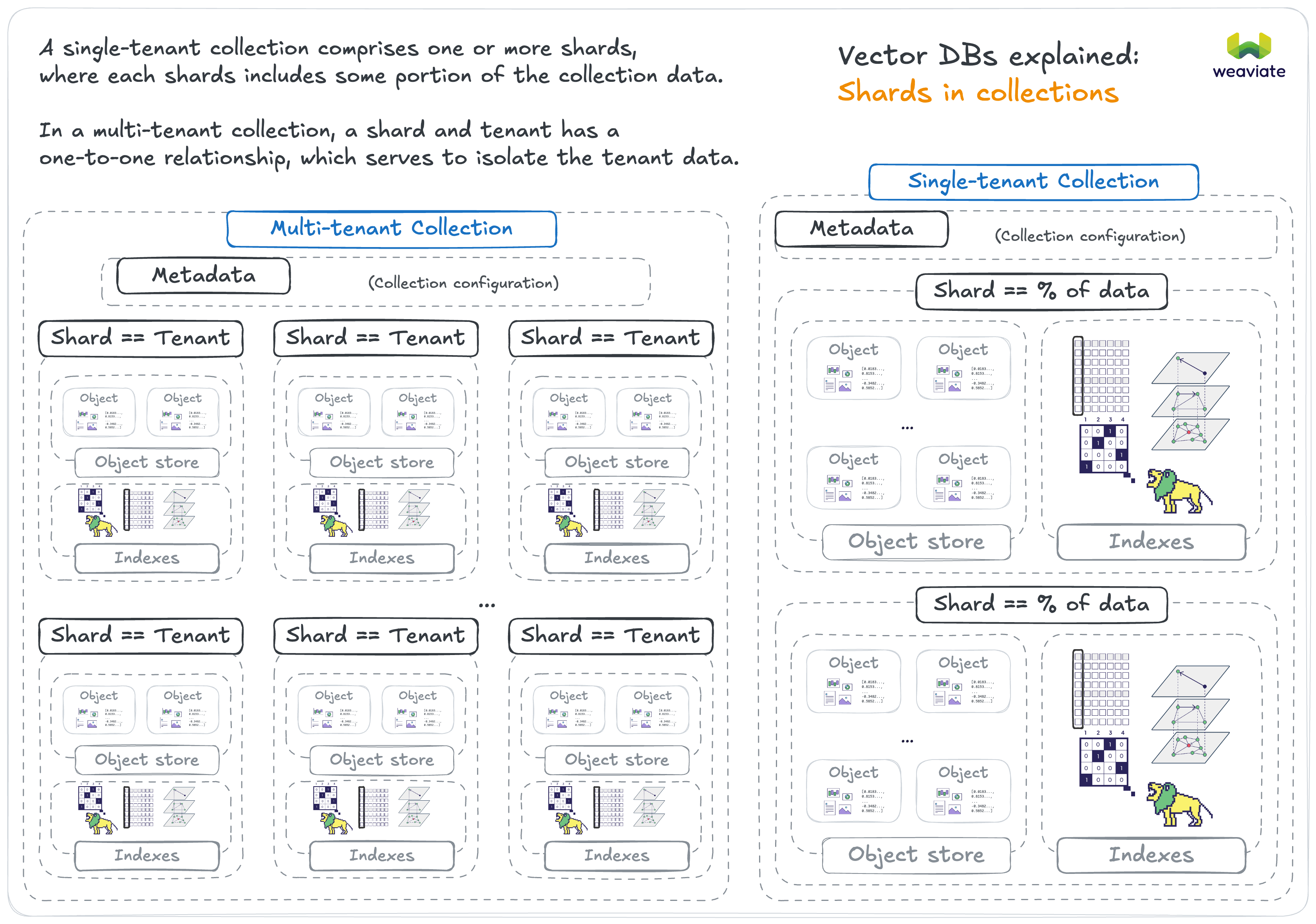
The number of unique shards in a single-tenant collection can only be set at collection creation time. In most cases, letting Weaviate manage the number of shards is sufficient. But in some cases, you may want to manually configure the number of shards for performance or data distribution reasons.
In a multi-tenant collection, each tenant consists of one shard. This means that the number of unique shards in a multi-tenant collection is equal to the number of tenants.
Replicas
Section titled “Replicas”Depending on the setup, each shard can have one or more "replicas", to be hosted on different nodes. This is referred to as a "high availability" setup, where the same data is available on multiple nodes. This allows for better read throughput and fault tolerance.
You can set the desired number of replicas, also called a replication factor, in Weaviate. This can be set a global cluster-level default using the REPLICATION_MINIMUM_FACTOR environment variable. It can also be set per collection, which will override the global default.
Motivation to scale Weaviate
Section titled “Motivation to scale Weaviate”Generally there are (at least) three distinct motivations to scale out horizontally which all will lead to different setups.
Motivation 1: Maximum Dataset Size
Section titled “Motivation 1: Maximum Dataset Size”Due to the memory footprint of an HNSW graph it may be desirable to spread a dataset across multiple servers ("nodes"). In such a setup, a single collection may be split into shards and shards are spread across nodes. The disk-based HFresh index can also reduce the need to shard purely for memory reasons.
Weaviate does the required orchestration at import and query time fully automatically.
See Sharding vs Replication below for trade-offs involved when running multiple shards.
Solution: Sharding across multiple nodes in a cluster
Motivation 2: Higher Query Throughput
Section titled “Motivation 2: Higher Query Throughput”When you receive more queries than a single Weaviate node can handle, it is desirable to add more Weaviate nodes which can help in responding to your users' queries.
Instead of sharding across multiple nodes, you can replicate (the same data) across multiple nodes. This process also happens fully automatically and you only need to specify the desired replication factor. Sharding and replication can also be combined.
Solution: Replicate your classes across multiple nodes in a cluster
Motivation 3: High Availability
Section titled “Motivation 3: High Availability”When serving critical loads with Weaviate, it may be desirable to be able to keep serving queries even if a node fails completely. Such a failure could be either due to a software or OS-level crash or even a hardware issue. Other than unexpected crashes, a highly available setup can also tolerate zero-downtime updates and other maintenance tasks.
To run a highly available setup, classes must be replicated among multiple nodes.
Solution: Replicate your classes across multiple nodes in a cluster
Sharding vs Replication
Section titled “Sharding vs Replication”The motivation sections above outline when it is desirable to shard your classes across multiple nodes and when it is desirable to replicate your classes - or both. This section highlights the implications of a sharded and/or replicated setup.
Advantages when increasing sharding
Section titled “Advantages when increasing sharding”- Run larger datasets
- Speed up imports.
To use multiple CPUs efficiently, create multiple shards for your collection. For the fastest imports, create multiple shards even on a single node.
Disadvantages when increasing sharding
Section titled “Disadvantages when increasing sharding”- Query throughput does not improve when adding more sharded nodes
Advantages when increasing replication
Section titled “Advantages when increasing replication”- System becomes highly available
- Increased replication leads to near-linearly increased query throughput
Disadvantages when increasing replication
Section titled “Disadvantages when increasing replication”- Import speed does not improve when adding more replicated nodes
Sharding Keys ("Partitioning Keys")
Section titled “Sharding Keys ("Partitioning Keys")”Weaviate uses specific characteristics of an object to decide which shard it belongs to. As of v1.8.0, a sharding key is always the object's UUID. The sharding algorithm is a 64bit Murmur-3 hash. Other properties and other algorithms for sharding may be added in the future.
Note that in a multi-tenant collection, each tenant consists of one shard.
Shard replica movement
Section titled “Shard replica movement”A shard replica can be moved or copied from one node to another. This is useful when you want to balance the load across nodes or when you want to change the replication factor of a part of a collection.
See this page for more details on how to move shard replicas.
Use cases for moving shard replicas
Section titled “Use cases for moving shard replicas”-
Load Balancing: If certain nodes are experiencing higher loads than others, moving shard replicas can help distribute the load more evenly across the cluster.
-
Scaling: If you need to scale your cluster (e.g., adding more nodes to handle increased load), shard replicas can be moved to the new nodes to ensure that the data is evenly distributed across the cluster.
-
Node Maintenance or Replacement: If a node requires maintenance (e.g., hardware upgrades) or replacement, shard replicas can be moved to temporary or replacement nodes to ensure continuous availability during the maintenance window.
Node Discovery
Section titled “Node Discovery”By default, Weaviate nodes in a cluster use a gossip-like protocol through Hashicorp's Memberlist to communicate node state and failure scenarios.
Weaviate - especially when running as a cluster - is optimized to run on Kubernetes. The Weaviate Helm chart makes use of a StatefulSet and a headless Service that automatically configures node discovery. All you have to do is specify the desired node count.
Node affinity of shards and/or replication shards
Section titled “Node affinity of shards and/or replication shards”Weaviate tries to select the node with the most available disk space.
This only applies when creating a new class, rather than when adding more data to an existing single class.
Consistency and current limitations
Section titled “Consistency and current limitations”- From
v1.25, Weaviate uses the Raft consensus algorithm for cluster metadata such as collection definitions and tenant activity statuses. Raft is a log-based algorithm coordinated by an elected leader, so cluster metadata changes remain consistent even if a minority of nodes fail, and concurrent schema changes are supported. For details, see Replication architecture: Cluster metadata.
If you are a Kubernetes user, see the1.25 migration guidebefore you upgrade. To upgrade, you have to delete your existing StatefulSet. - Adding a node to an existing cluster does not by itself change the ownership of existing shards. To rebalance data across nodes, or to drain a node before you remove it, move its shard replicas with replica movement as described in Shard replica movement above.
Behavior before v1.25 and v1.32
Prior to v1.25, schema changes were broadcast across the cluster with a form of two-phase transaction that could not tolerate node failures during the lifetime of the transaction. Raft replaced this mechanism. See Replication architecture: Cluster metadata for the comparison.
Prior to v1.32, shard replicas could not be moved between nodes, so a node that still held data could not be removed from a cluster. Replica movement removes that limitation.
Questions and feedback
Section titled “Questions and feedback”Have a question or feedback? Here's how to reach us.