Text Embeddings
Weaviate's integration with Databricks' APIs allows you to access models hosted on their platform directly from Weaviate.
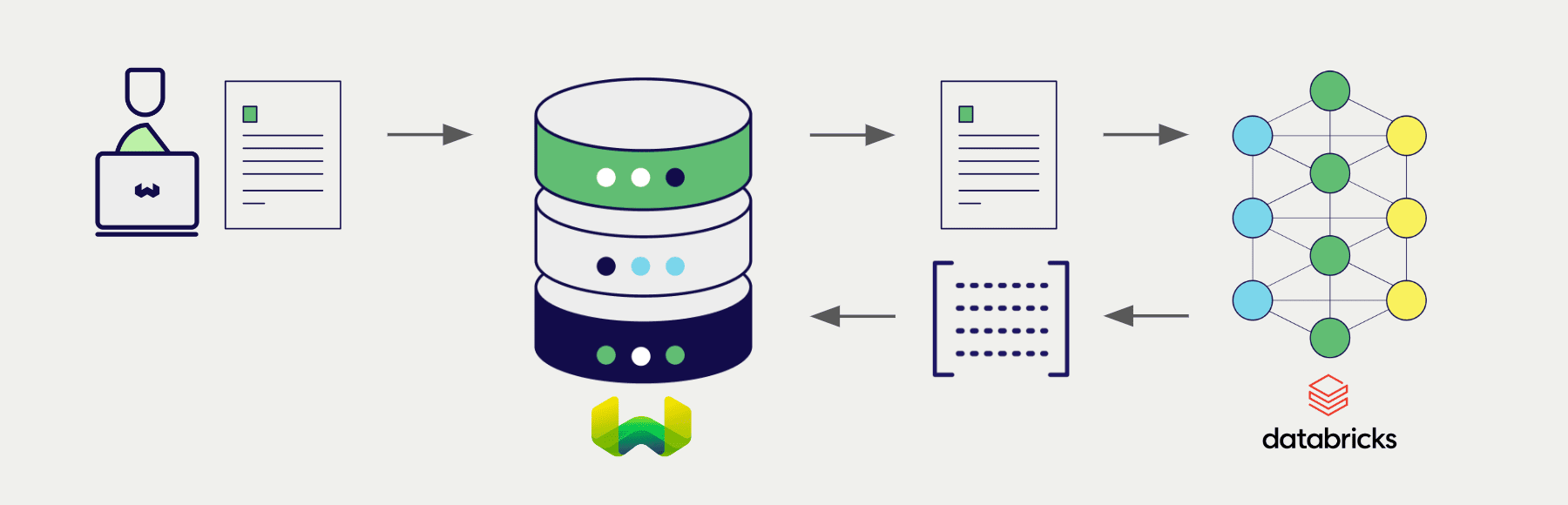
Configure a Weaviate vector index to use a Databricks embedding model, and Weaviate will generate embeddings for various operations using the specified endpoint and your Databricks token. This feature is called the vectorizer.
At import time, Weaviate generates text object embeddings and saves them into the index. For vector and hybrid search operations, Weaviate converts text queries into embeddings.
Requirements
Section titled “Requirements”Weaviate configuration
Section titled “Weaviate configuration”Your Weaviate instance must be configured with the Databricks vectorizer integration (text2vec-databricks) module.
For Weaviate Cloud (WCD) users
This integration is enabled by default on Weaviate Cloud (WCD) instances.
For self-hosted users
- Check the cluster metadata to verify if the module is enabled.
- Follow the how-to configure modules guide to enable the module in Weaviate.
Databricks Personal Access Token
Section titled “Databricks Personal Access Token”You must provide a valid Databricks Personal Access Token (PAT) to Weaviate for this integration. Refer to the Databricks documentation for instructions on generating your PAT in your workspace.
Provide the Databricks token to Weaviate using one of the following methods:
- Set the
DATABRICKS_TOKENenvironment variable that is available to Weaviate. - Provide the token at runtime, as shown in the examples below.
# Recommended: save sensitive data as environment variables
databricks_token = os.getenv("DATABRICKS_TOKEN")const databricksToken = process.env.DATABRICKS_TOKEN || ''; // Replace with your inference API key"X-Databricks-Token": os.Getenv("DATABRICKS_TOKEN"),Configure the vectorizer
Section titled “Configure the vectorizer”Configure a Weaviate index to use a Databricks serving model endpoint by setting the vectorizer as follows:
import osfrom weaviate.classes.config import Configuredatabricks_vectorizer_endpoint = os.getenv("DATABRICKS_VECTORIZER_ENDPOINT") # If saved as an environment variableclient.collections.create( "DemoCollection", vector_config=[ Configure.Vectors.text2vec_databricks( endpoint=databricks_vectorizer_endpoint, # Required for Databricks name="title_vector", source_properties=["title"], ) ], # Additional parameters not shown)const databricksVectorizerEndpoint = process.env.DATABRICKS_VECTORIZER_ENDPOINT || ''; // If saved as an environment variableawait client.collections.create({ name: 'DemoCollection', properties: [ { name: 'title', dataType: 'text' as const, }, ], vectorizers: [ weaviate.configure.vectors.text2VecDatabricks({ endpoint: databricksVectorizerEndpoint, // Required for Databricks name: 'title_vector', sourceProperties: ['title'], }) ], // Additional parameters not shown});// Define the collectionbasicDatabricksVectorizerDef := &models.Class{ Class: "DemoCollection", VectorConfig: map[string]models.VectorConfig{ "title_vector": { Vectorizer: map[string]interface{}{ "text2vec-databricks": map[string]interface{}{ "properties": []string{"title"}, "endpoint": "<databricks_vectorizer_endpoint>", // Required for Databricks }, }, }, },}// add the collectionerr = client.Schema().ClassCreator().WithClass(basicDatabricksVectorizerDef).Do(ctx)if err != nil { panic(err)}This will configure Weaviate to use the vectorizer served through the endpoint you specify.
Vectorizer parameters
Section titled “Vectorizer parameters”endpoint: The URL of the embedding model hosted on Databricks.instruction: An optional instruction to pass to the embedding model.
For further details on model parameters, see the Databricks documentation.
Header parameters
Section titled “Header parameters”You can provide the token as well as some optional parameters at runtime through additional headers in the request. The following headers are available:
X-Databricks-Token: The Databricks API token.X-Databricks-Endpoint: The endpoint to use for the Databricks model.X-Databricks-User-Agent: The user agent to use for the Databricks model.
Any additional headers provided at runtime will override the existing Weaviate configuration.
Provide the headers as shown in the API credentials examples above.
Data import
Section titled “Data import”After configuring the vectorizer, import data into Weaviate. Weaviate generates embeddings for text objects using the specified model.
source_objects = [ {"title": "The Shawshank Redemption", "description": "A wrongfully imprisoned man forms an inspiring friendship while finding hope and redemption in the darkest of places."}, {"title": "The Godfather", "description": "A powerful mafia family struggles to balance loyalty, power, and betrayal in this iconic crime saga."}, {"title": "The Dark Knight", "description": "Batman faces his greatest challenge as he battles the chaos unleashed by the Joker in Gotham City."}, {"title": "Jingle All the Way", "description": "A desperate father goes to hilarious lengths to secure the season's hottest toy for his son on Christmas Eve."}, {"title": "A Christmas Carol", "description": "A miserly old man is transformed after being visited by three ghosts on Christmas Eve in this timeless tale of redemption."}]collection = client.collections.use("DemoCollection")with collection.batch.fixed_size(batch_size=200) as batch: for src_obj in source_objects: # The model provider integration will automatically vectorize the object batch.add_object( properties={ "title": src_obj["title"], "description": src_obj["description"], }, # vector=vector # Optionally provide a pre-obtained vector ) if batch.number_errors > 10: print("Batch import stopped due to excessive errors.") breakfailed_objects = collection.batch.failed_objectsif failed_objects: print(f"Number of failed imports: {len(failed_objects)}") print(f"First failed object: {failed_objects[0]}")let srcObjects = [
{ title: "The Shawshank Redemption", description: "A wrongfully imprisoned man forms an inspiring friendship while finding hope and redemption in the darkest of places." },
{ title: "The Godfather", description: "A powerful mafia family struggles to balance loyalty, power, and betrayal in this iconic crime saga." },
{ title: "The Dark Knight", description: "Batman faces his greatest challenge as he battles the chaos unleashed by the Joker in Gotham City." },
{ title: "Jingle All the Way", description: "A desperate father goes to hilarious lengths to secure the season's hottest toy for his son on Christmas Eve." },
{ title: "A Christmas Carol", description: "A miserly old man is transformed after being visited by three ghosts on Christmas Eve in this timeless tale of redemption." }
];var sourceObjects = []map[string]string{ {"title": "The Shawshank Redemption", "description": "A wrongfully imprisoned man forms an inspiring friendship while finding hope and redemption in the darkest of places."}, {"title": "The Godfather", "description": "A powerful mafia family struggles to balance loyalty, power, and betrayal in this iconic crime saga."}, {"title": "The Dark Knight", "description": "Batman faces his greatest challenge as he battles the chaos unleashed by the Joker in Gotham City."}, {"title": "Jingle All the Way", "description": "A desperate father goes to hilarious lengths to secure the season's hottest toy for his son on Christmas Eve."}, {"title": "A Christmas Carol", "description": "A miserly old man is transformed after being visited by three ghosts on Christmas Eve in this timeless tale of redemption."},}// Convert items into a slice of models.Objectobjects := []models.PropertySchema{}for i := range sourceObjects { objects = append(objects, map[string]interface{}{ // Populate the object with the data "title": sourceObjects[i]["title"], "description": sourceObjects[i]["description"], })}// Batch write itemsbatcher := client.Batch().ObjectsBatcher()for _, dataObj := range objects { batcher.WithObjects(&models.Object{ Class: "DemoCollection", Properties: dataObj, })}// FlushbatchRes, err := batcher.Do(ctx)// Error handlingif err != nil { panic(err)}for _, res := range batchRes { if res.Result.Errors != nil { for _, err := range res.Result.Errors.Error { if err != nil { fmt.Printf("Error details: %v\n", *err) panic(err.Message) } } }}Searches
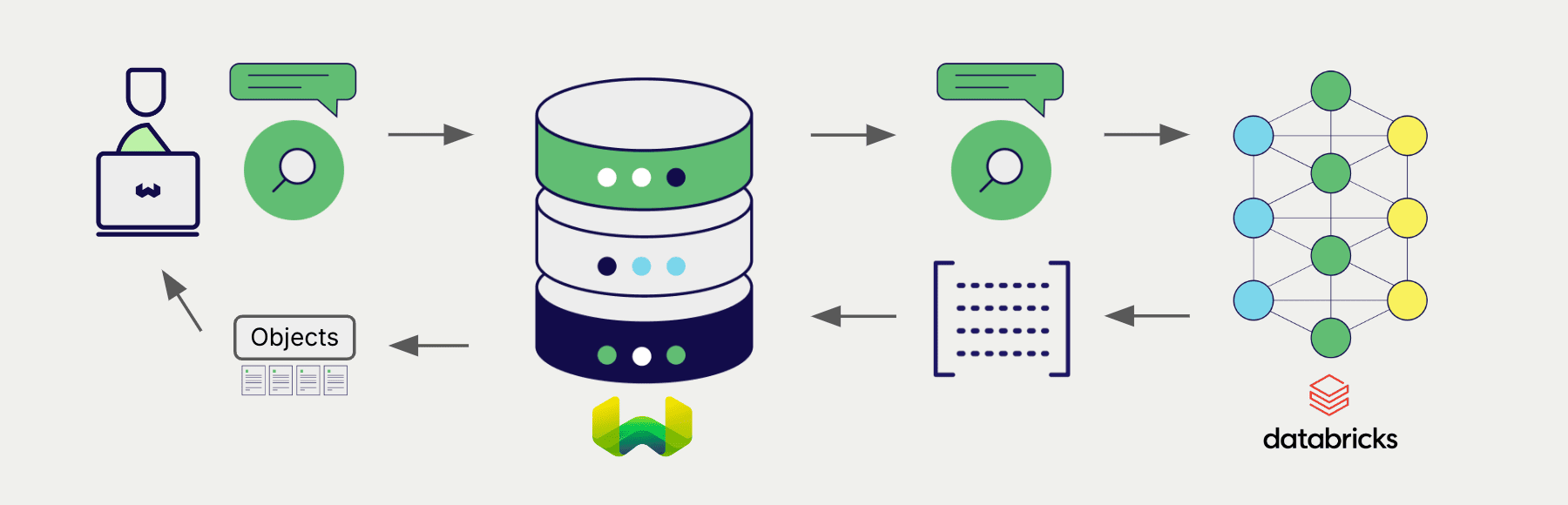
Section titled “Searches”Once the vectorizer is configured, Weaviate will perform vector and hybrid search operations using the specified model.
Vector (near text) search
Section titled “Vector (near text) search”When you perform a vector search, Weaviate converts the text query into an embedding using the specified model and returns the most similar objects from the database.
The query below returns the n most similar objects from the database, set by limit.
collection = client.collections.use("DemoCollection")response = collection.query.near_text( query="A holiday film", # The model provider integration will automatically vectorize the query limit=2)for obj in response.objects: print(obj.properties["title"])const collectionName = 'DemoCollection'
const myCollection = client.collections.use(collectionName)nearTextResponse, err := client.GraphQL().Get(). WithClassName("DemoCollection"). WithFields( graphql.Field{Name: "title"}, ). WithNearText(client.GraphQL().NearTextArgBuilder(). WithConcepts([]string{"A holiday film"})). WithLimit(2). Do(ctx)if err != nil { panic(err)}fmt.Printf("%v", nearTextResponse)Hybrid search
Section titled “Hybrid search”When you perform a hybrid search, Weaviate converts the text query into an embedding using the specified model and returns the best scoring objects from the database.
The query below returns the n best scoring objects from the database, set by limit.
collection = client.collections.use("DemoCollection")response = collection.query.hybrid( query="A holiday film", # The model provider integration will automatically vectorize the query limit=2)for obj in response.objects: print(obj.properties["title"])const collectionName = 'DemoCollection'
const myCollection = client.collections.use(collectionName)hybridResponse, err := client.GraphQL().Get(). WithClassName("DemoCollection"). WithFields( graphql.Field{Name: "title"}, ). WithHybrid(client.GraphQL().HybridArgumentBuilder(). WithQuery("A holiday film")). WithLimit(2). Do(ctx)if err != nil { panic(err)}fmt.Printf("%v", hybridResponse)References
Section titled “References”Further resources
Section titled “Further resources”Other integrations
Section titled “Other integrations”Code examples
Section titled “Code examples”Once the integrations are configured at the collection, the data management and search operations in Weaviate work identically to any other collection. See the following model-agnostic examples:
- The How-to: Manage collections and How-to: Manage objects guides show how to perform data operations (i.e. create, read, update, delete collections and objects within them).
- The How-to: Query & Search guides show how to perform search operations (i.e. vector, keyword, hybrid) as well as retrieval augmented generation.
External resources
Section titled “External resources”- Databricks Foundation model REST API reference
Questions and feedback
Section titled “Questions and feedback”Have a question or feedback? Here's how to reach us.