Text Embeddings
Weaviate Cloud only
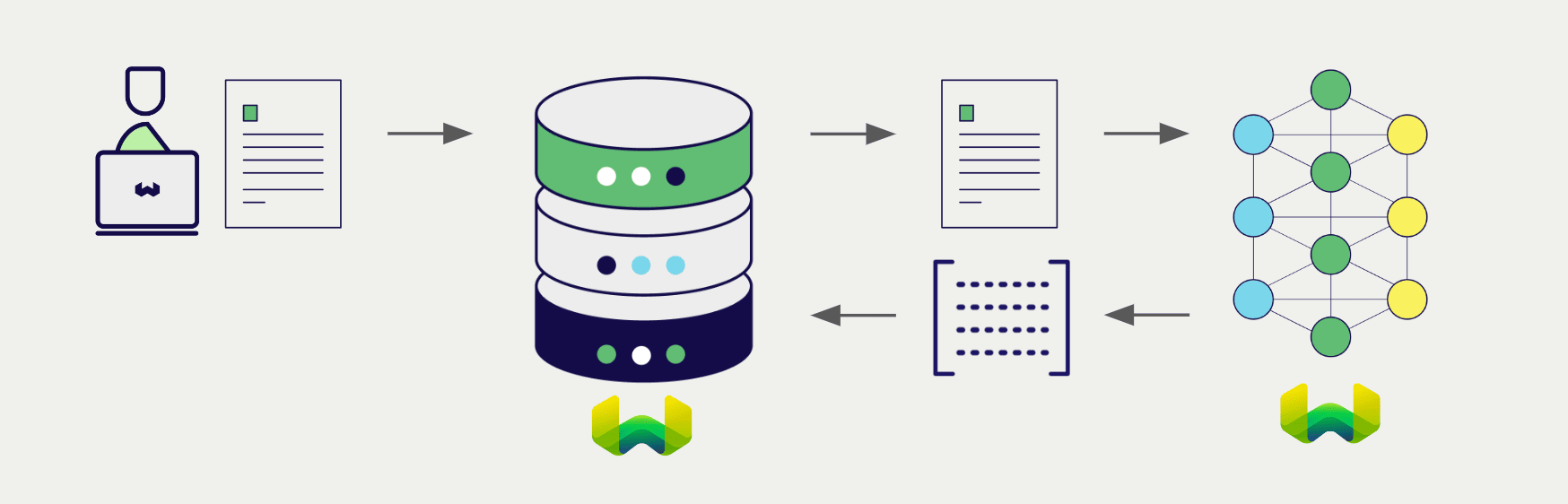
Configure a Weaviate vector index to use a Weaviate Embeddings model, and Weaviate will generate embeddings for various operations using the specified model and your Weaviate API key. This feature is called the vectorizer.
At import time, Weaviate generates text object embeddings and saves them into the index. For vector and hybrid search operations, Weaviate converts text queries into embeddings.
Requirements
Section titled “Requirements”To use Weaviate Embeddings, you need a Weaviate Cloud instance with a Weaviate client library that supports Weaviate Embeddings.
API credentials
Section titled “API credentials”Your Weaviate Cloud credentials are automatically used to authorize your access to Weaviate Embeddings.
import weaviate
from weaviate.classes.init import Auth
import os

# Best practice: store your credentials in environment variables
weaviate_url = os.getenv("WEAVIATE_URL")
weaviate_key = os.getenv("WEAVIATE_API_KEY")

client = weaviate.connect_to_weaviate_cloud(
    cluster_url=weaviate_url,                     # Weaviate URL: "REST Endpoint" in Weaviate Cloud console
    auth_credentials=Auth.api_key(weaviate_key),  # Weaviate API key: "ADMIN" API key in Weaviate Cloud console
)

print(client.is_ready())  # Should print: `True`

# Work with Weaviate

client.close()import weaviate from 'weaviate-client'
// Best practice: store your credentials in environment variables
const weaviateUrl = process.env.WEAVIATE_URL as string; // Weaviate URL: "REST Endpoint" in Weaviate Cloud console
const weaviateApiKey = process.env.WEAVIATE_API_KEY as string; // Weaviate API key: "ADMIN" API key in Weaviate Cloud console
const client = await weaviate.connectToWeaviateCloud(
weaviateUrl,
{
authCredentials: new weaviate.ApiKey(weaviateApiKey),
}
)
// Work with Weaviate
client.close()// Best practice: store your credentials in environment variablesString weaviateUrl = System.getenv("WEAVIATE_URL");String weaviateApiKey = System.getenv("WEAVIATE_API_KEY");WeaviateClient client = WeaviateClient.connectToWeaviateCloud(weaviateUrl, // Replace with your // Weaviate Cloud URL weaviateApiKey // Replace with your Weaviate Cloud key);System.out.println(client.isReady()); // Should print: `True`client.close(); // Free up resources// Best practice: store your credentials in environment variablesstring weaviateUrl = Environment.GetEnvironmentVariable("WEAVIATE_URL");string weaviateApiKey = Environment.GetEnvironmentVariable("WEAVIATE_API_KEY");using var client = await Connect.Cloud( weaviateUrl, // Replace with your Weaviate Cloud URL weaviateApiKey // Replace with your Weaviate Cloud key);var meta = await client.GetMeta();Console.WriteLine(meta.Version);Configure the vectorizer
Section titled “Configure the vectorizer”Configure a Weaviate index as follows to use a Weaviate Embeddings model:
from weaviate.classes.config import Configureclient.collections.create( "DemoCollection", vector_config=[ Configure.Vectors.text2vec_weaviate( name="title_vector", source_properties=["title"] ) ], # Additional parameters not shown)await client.collections.create({ name: 'DemoCollection', properties: [ { name: 'title', dataType: 'text' as const, }, ], vectorizers: [ weaviate.configure.vectors.text2VecWeaviate({ name: 'title_vector', sourceProperties: ['title'], }, ), ], // Additional parameters not shown});// Define the collectionbasicWeaviateVectorizerDef := &models.Class{ Class: "DemoCollection", VectorConfig: map[string]models.VectorConfig{ "title_vector": { Vectorizer: map[string]interface{}{ "text2vec-weaviate": map[string]interface{}{}, }, }, },}// add the collectionerr = client.Schema().ClassCreator().WithClass(basicWeaviateVectorizerDef).Do(ctx)if err != nil { panic(err)}client.collections.create("DemoCollection",
col -> col
.vectorConfig(
VectorConfig.text2vecWeaviate("title_vector", c -> c.sourceProperties("title")))
.properties(Property.text("title"), Property.text("description")));await client.Collections.Create(
new CollectionCreateParams
{
Name = "DemoCollection",
VectorConfig = new VectorConfigList
{
Configure.Vector(
"title_vector",
v => v.Text2VecWeaviate(),
sourceProperties: ["title"]
),
},
Properties = [Property.Text("title"), Property.Text("description")],
}
);Select a model
Section titled “Select a model”You can specify one of the available models for the vectorizer to use, as shown in the following configuration example.
from weaviate.classes.config import Configureclient.collections.create( "DemoCollection", vector_config=[ Configure.Vectors.text2vec_weaviate( name="title_vector", source_properties=["title"], model="Snowflake/snowflake-arctic-embed-l-v2.0" ) ], # Additional parameters not shown)await client.collections.create({ name: 'DemoCollection', properties: [ { name: 'title', dataType: 'text' as const, }, ], vectorizers: [ weaviate.configure.vectors.text2VecWeaviate({ name: 'title_vector', sourceProperties: ['title'], model: 'Snowflake/snowflake-arctic-embed-l-v2.0', }), ], // Additional parameters not shown});// Define the collectionweaviateVectorizerWithModelDef := &models.Class{ Class: "DemoCollection", VectorConfig: map[string]models.VectorConfig{ "title_vector": { Vectorizer: map[string]interface{}{ "text2vec-weaviate": map[string]interface{}{ "model": "arctic-embed-l-v2.0", }, }, }, },}// add the collectionerr = client.Schema().ClassCreator().WithClass(weaviateVectorizerWithModelDef).Do(ctx)if err != nil { panic(err)}client.collections
.create("DemoCollection",
col -> col
.vectorConfig(VectorConfig.text2vecWeaviate("title_vector",
c -> c.sourceProperties("title")
.model("Snowflake/snowflake-arctic-embed-l-v2.0")))
.properties(Property.text("title"), Property.text("description")));await client.Collections.Create(
new CollectionCreateParams
{
Name = "DemoCollection",
VectorConfig = new VectorConfigList
{
Configure.Vector(
"title_vector",
v => v.Text2VecWeaviate(model: "Snowflake/snowflake-arctic-embed-l-v2.0"),
sourceProperties: ["title"]
),
},
Properties = [Property.Text("title"), Property.Text("description")],
}
);You can specify one of the available models for Weaviate to use. The default model is used if no model is specified.
Vectorization behavior
Weaviate follows the collection configuration and a set of predetermined rules to vectorize objects.
Unless specified otherwise in the collection definition, the default behavior is to:
- Only vectorize properties that use the
textortext[]data type (unless skipped) - Sort properties in alphabetical (a-z) order before concatenating values
- If
vectorizePropertyNameistrue(falseby default) prepend the property name to each property value - Join the (prepended) property values with spaces
- Prepend the class name (unless
vectorizeClassNameisfalse) - Convert the produced string to lowercase
Vectorizer parameters
Section titled “Vectorizer parameters”model(optional): The name of the model to use for embedding generation.dimensions(optional): The number of dimensions to use for the generated embeddings.base_url(optional): The base URL for the Weaviate Embeddings service. (Not required in most cases.)
The following examples show how to configure Weaviate Embeddings-specific options.
from weaviate.classes.config import Configureclient.collections.create( "DemoCollection", vector_config=[ Configure.Vectors.text2vec_weaviate( name="title_vector", source_properties=["title"], model="Snowflake/snowflake-arctic-embed-m-v1.5", # Further options # dimensions=256 # base_url="<custom_weaviate_embeddings_url>", ) ], # Additional parameters not shown)await client.collections.create({ name: 'DemoCollection', properties: [ { name: 'title', dataType: 'text' as const, }, ], vectorizers: [ weaviate.configure.vectors.text2VecWeaviate({ name: 'title_vector', sourceProperties: ['title'], model: 'Snowflake/snowflake-arctic-embed-m-v1.5', // Further options // dimensions: 256, // baseURL: '<custom_weaviate_embeddings_url>', }, ), ], // Additional parameters not shown});// Define the collectionweaviateVectorizerArcticEmbedMV15 := &models.Class{ Class: "DemoCollection", VectorConfig: map[string]models.VectorConfig{ "title_vector": { Vectorizer: map[string]interface{}{ "text2vec-weaviate": map[string]interface{}{ "model": "Snowflake/snowflake-arctic-embed-m-v1.5", "dimensions": 256, // Or 768 "base_url": "<custom_weaviate_url>", }, }, }, },}// add the collectionerr = client.Schema().ClassCreator().WithClass(weaviateVectorizerArcticEmbedMV15).Do(ctx)if err != nil { panic(err)}client.collections.create("DemoCollection",
col -> col.vectorConfig(VectorConfig.text2vecWeaviate("title_vector",
c -> c.sourceProperties("title").model("Snowflake/snowflake-arctic-embed-m-v1.5")
// .inferenceUrl(null)
// .dimensions(0)
)).properties(Property.text("title"), Property.text("description")));await client.Collections.Create(
new CollectionCreateParams
{
Name = "DemoCollection",
VectorConfig = new VectorConfigList
{
Configure.Vector(
"title_vector",
v =>
v.Text2VecWeaviate(
model: "Snowflake/snowflake-arctic-embed-m-v1.5"
// baseURL: null,
// dimensions: 0
),
sourceProperties: ["title"]
),
},
Properties = [Property.Text("title"), Property.Text("description")],
}
);Data import
Section titled “Data import”After configuring the vectorizer, import data into Weaviate. Weaviate generates embeddings for text objects using the specified model.
source_objects = [ {"title": "The Shawshank Redemption", "description": "A wrongfully imprisoned man forms an inspiring friendship while finding hope and redemption in the darkest of places."}, {"title": "The Godfather", "description": "A powerful mafia family struggles to balance loyalty, power, and betrayal in this iconic crime saga."}, {"title": "The Dark Knight", "description": "Batman faces his greatest challenge as he battles the chaos unleashed by the Joker in Gotham City."}, {"title": "Jingle All the Way", "description": "A desperate father goes to hilarious lengths to secure the season's hottest toy for his son on Christmas Eve."}, {"title": "A Christmas Carol", "description": "A miserly old man is transformed after being visited by three ghosts on Christmas Eve in this timeless tale of redemption."}]collection = client.collections.use("DemoCollection")with collection.batch.fixed_size(batch_size=200) as batch: for src_obj in source_objects: # The model provider integration will automatically vectorize the object batch.add_object( properties={ "title": src_obj["title"], "description": src_obj["description"], }, # vector=vector # Optionally provide a pre-obtained vector ) if batch.number_errors > 10: print("Batch import stopped due to excessive errors.") breakfailed_objects = collection.batch.failed_objectsif failed_objects: print(f"Number of failed imports: {len(failed_objects)}") print(f"First failed object: {failed_objects[0]}")let srcObjects = [
{ title: "The Shawshank Redemption", description: "A wrongfully imprisoned man forms an inspiring friendship while finding hope and redemption in the darkest of places." },
{ title: "The Godfather", description: "A powerful mafia family struggles to balance loyalty, power, and betrayal in this iconic crime saga." },
{ title: "The Dark Knight", description: "Batman faces his greatest challenge as he battles the chaos unleashed by the Joker in Gotham City." },
{ title: "Jingle All the Way", description: "A desperate father goes to hilarious lengths to secure the season's hottest toy for his son on Christmas Eve." },
{ title: "A Christmas Carol", description: "A miserly old man is transformed after being visited by three ghosts on Christmas Eve in this timeless tale of redemption." }
];var sourceObjects = []map[string]string{ {"title": "The Shawshank Redemption", "description": "A wrongfully imprisoned man forms an inspiring friendship while finding hope and redemption in the darkest of places."}, {"title": "The Godfather", "description": "A powerful mafia family struggles to balance loyalty, power, and betrayal in this iconic crime saga."}, {"title": "The Dark Knight", "description": "Batman faces his greatest challenge as he battles the chaos unleashed by the Joker in Gotham City."}, {"title": "Jingle All the Way", "description": "A desperate father goes to hilarious lengths to secure the season's hottest toy for his son on Christmas Eve."}, {"title": "A Christmas Carol", "description": "A miserly old man is transformed after being visited by three ghosts on Christmas Eve in this timeless tale of redemption."},}// Convert items into a slice of models.Objectobjects := []models.PropertySchema{}for i := range sourceObjects { objects = append(objects, map[string]interface{}{ // Populate the object with the data "title": sourceObjects[i]["title"], "description": sourceObjects[i]["description"], })}// Batch write itemsbatcher := client.Batch().ObjectsBatcher()for _, dataObj := range objects { batcher.WithObjects(&models.Object{ Class: "DemoCollection", Properties: dataObj, })}// FlushbatchRes, err := batcher.Do(ctx)// Error handlingif err != nil { panic(err)}for _, res := range batchRes { if res.Result.Errors != nil { for _, err := range res.Result.Errors.Error { if err != nil { fmt.Printf("Error details: %v\n", *err) panic(err.Message) } } }}// Define the source objects
List<Map<String, Object>> sourceObjects = List.of(Map.of("title", "The Shawshank Redemption",
"description",
"A wrongfully imprisoned man forms an inspiring friendship while finding hope and redemption in the darkest of places."),
Map.of("title", "The Godfather", "description",
"A powerful mafia family struggles to balance loyalty, power, and betrayal in this iconic crime saga."),
Map.of("title", "The Dark Knight", "description",
"Batman faces his greatest challenge as he battles the chaos unleashed by the Joker in Gotham City."),
Map.of("title", "Jingle All the Way", "description",
"A desperate father goes to hilarious lengths to secure the season's hottest toy for his son on Christmas Eve."),
Map.of("title", "A Christmas Carol", "description",
"A miserly old man is transformed after being visited by three ghosts on Christmas Eve in this timeless tale of redemption."));
// Get a handle to the collection
CollectionHandle<Map<String, Object>> collection = client.collections.use("DemoCollection");
// Insert the data using insertMany
InsertManyResponse response = collection.data.insertMany(sourceObjects.toArray(new Map[0]));
// Check for errors
if (!response.errors().isEmpty()) {
System.err.printf("Number of failed imports: %d\n", response.errors().size());
System.err.printf("First failed object error: %s\n", response.errors().get(0));
} else {
System.out.printf("Successfully inserted %d objects.\n", response.uuids().size());
}// Define the source objects
var sourceObjects = new[]
{
new
{
title = "The Shawshank Redemption",
description = "A wrongfully imprisoned man forms an inspiring friendship while finding hope and redemption in the darkest of places.",
},
new
{
title = "The Godfather",
description = "A powerful mafia family struggles to balance loyalty, power, and betrayal in this iconic crime saga.",
},
new
{
title = "The Dark Knight",
description = "Batman faces his greatest challenge as he battles the chaos unleashed by the Joker in Gotham City.",
},
new
{
title = "Jingle All the Way",
description = "A desperate father goes to hilarious lengths to secure the season's hottest toy for his son on Christmas Eve.",
},
new
{
title = "A Christmas Carol",
description = "A miserly old man is transformed after being visited by three ghosts on Christmas Eve in this timeless tale of redemption.",
},
};
// Get a handle to the collection
var collection = client.Collections.Use("DemoCollection");
// Insert the data using insertMany
var response = await collection.Data.InsertMany(sourceObjects);
// Check for errors
if (response.HasErrors)
{
Console.WriteLine($"Number of failed imports: {response.Errors.Count()}");
Console.WriteLine($"First failed object error: {response.Errors.First().Message}");
}
else
{
Console.WriteLine($"Successfully inserted {response.Objects.Count()} objects.");
}Searches
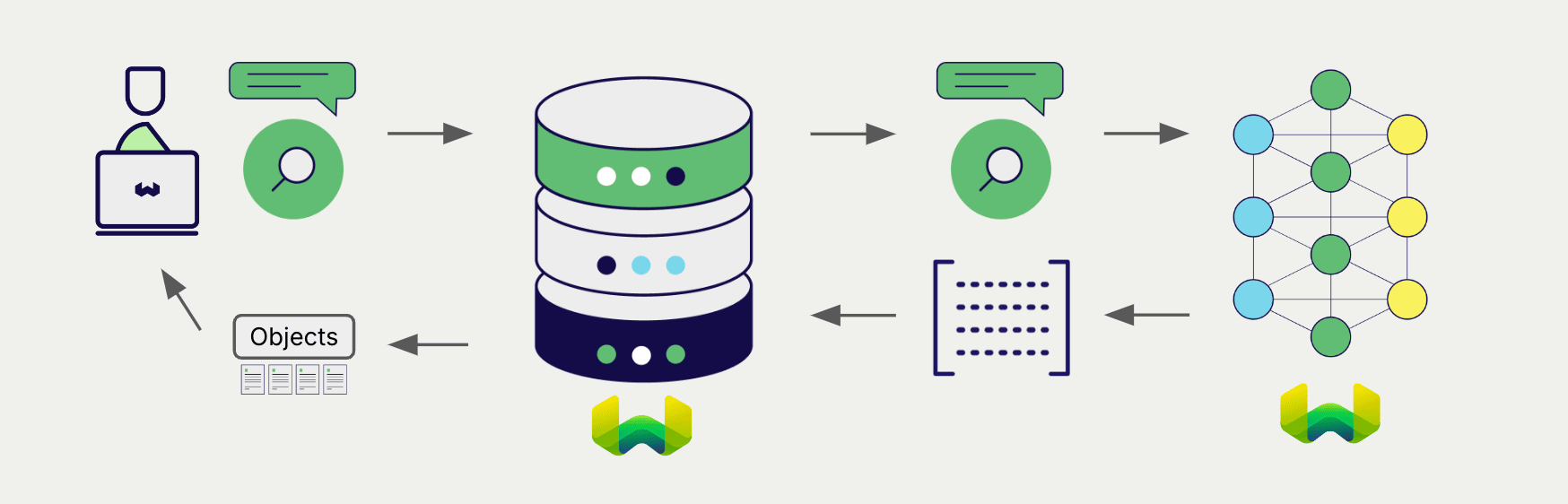
Section titled “Searches”Once the vectorizer is configured, Weaviate will perform vector and hybrid search operations using the specified WED model.
Vector (near text) search
Section titled “Vector (near text) search”When you perform a vector search, Weaviate converts the text query into an embedding using the specified model and returns the most similar objects from the database.
The query below returns the n most similar objects from the database, set by limit.
collection = client.collections.use("DemoCollection")response = collection.query.near_text( query="A holiday film", # The model provider integration will automatically vectorize the query limit=2)for obj in response.objects: print(obj.properties["title"])const collectionName = 'DemoCollection'
const myCollection = client.collections.use(collectionName)nearTextResponse, err := client.GraphQL().Get(). WithClassName("DemoCollection"). WithFields( graphql.Field{Name: "title"}, ). WithNearText(client.GraphQL().NearTextArgBuilder(). WithConcepts([]string{"A holiday film"})). WithLimit(2). Do(ctx)if err != nil { panic(err)}fmt.Printf("%v", nearTextResponse)CollectionHandle<Map<String, Object>> collection = client.collections.use("DemoCollection");var response = collection.query.nearText("A holiday film", // The model provider integration will automatically vectorize the query q -> q.limit(2).returnMetadata(Metadata.DISTANCE));for (var o : response.objects()) { System.out.println(o.properties().get("title"));}var collection = client.Collections.Use("DemoCollection");var response = await collection.Query.NearText( "A holiday film", // The model provider integration will automatically vectorize the query limit: 2, returnMetadata: MetadataOptions.Distance);foreach (var o in response.Objects){ Console.WriteLine(o.Properties["title"]);}Hybrid search
Section titled “Hybrid search”When you perform a hybrid search, Weaviate converts the text query into an embedding using the specified model and returns the best scoring objects from the database.
The query below returns the n best scoring objects from the database, set by limit.
collection = client.collections.use("DemoCollection")response = collection.query.hybrid( query="A holiday film", # The model provider integration will automatically vectorize the query limit=2)for obj in response.objects: print(obj.properties["title"])const collectionName = 'DemoCollection'
const myCollection = client.collections.use(collectionName)hybridResponse, err := client.GraphQL().Get(). WithClassName("DemoCollection"). WithFields( graphql.Field{Name: "title"}, ). WithHybrid(client.GraphQL().HybridArgumentBuilder(). WithQuery("A holiday film")). WithLimit(2). Do(ctx)if err != nil { panic(err)}fmt.Printf("%v", hybridResponse)CollectionHandle<Map<String, Object>> collection = client.collections.use("DemoCollection");QueryResponse<Map<String, Object>> response = collection.query.hybrid("A holiday film", // The model provider integration will automatically vectorize the query q -> q.limit(2).returnMetadata(Metadata.DISTANCE));for (var o : response.objects()) { System.out.println(o.properties().get("title"));}var collection = client.Collections.Use("DemoCollection");var response = await collection.Query.Hybrid( "A holiday film", // The model provider integration will automatically vectorize the query limit: 2, returnMetadata: MetadataOptions.Distance);foreach (var o in response.Objects){ Console.WriteLine(o.Properties["title"]);}Available models
Section titled “Available models”Snowflake/snowflake-arctic-embed-l-v2.0 (default)
Section titled “Snowflake/snowflake-arctic-embed-l-v2.0 (default)”- A 568M parameter, 1024-dimensional model for multilingual enterprise retrieval tasks.
- Trained with Matryoshka Representation Learning to allow vector truncation with minimal loss.
- Quantization-friendly: Using scalar quantization and 256 dimensions provides 99% of unquantized, full-precision performance.
- Read more at the Snowflake blog, and the Hugging Face model card
- Allowable
dimensions: 1024 (default), 256
Snowflake/snowflake-arctic-embed-m-v1.5
Section titled “Snowflake/snowflake-arctic-embed-m-v1.5”- A 109M parameter, 768-dimensional model for enterprise retrieval tasks in English.
- Trained with Matryoshka Representation Learning to allow vector truncation with minimal loss.
- Quantization-friendly: Using scalar quantization and 256 dimensions provides 99% of unquantized, full-precision performance.
- Read more at the Snowflake blog, and the Hugging Face model card
- Allowable
dimensions: 768 (default), 256
Further resources
Section titled “Further resources”Code examples
Section titled “Code examples”Once the integrations are configured at the collection, the data management and search operations in Weaviate work identically to any other collection. See the following model-agnostic examples:
- The How-to: Manage collections and How-to: Manage objects guides show how to perform data operations (i.e. create, read, update, delete collections and objects within them).
- The How-to: Query & Search guides show how to perform search operations (i.e. vector, keyword, hybrid) as well as retrieval augmented generation.
Multimodal embeddings
Section titled “Multimodal embeddings”Looking to embed document images instead of text? See Weaviate Embeddings: Multimodal for visual document retrieval without OCR or preprocessing.
References
Section titled “References”- Weaviate Embeddings Documentation
- Weaviate Embeddings Models
Pricing
Section titled “Pricing”Weaviate Embeddings models are charged based on token usage. For more pricing information, see the Weaviate Cloud pricing page.
Questions and feedback
Section titled “Questions and feedback”Have a question or feedback? Here's how to reach us.