Generative AI
Weaviate's integration with Google Gemini API and Google Vertex AI APIs allows you to access their models' capabilities directly from Weaviate.
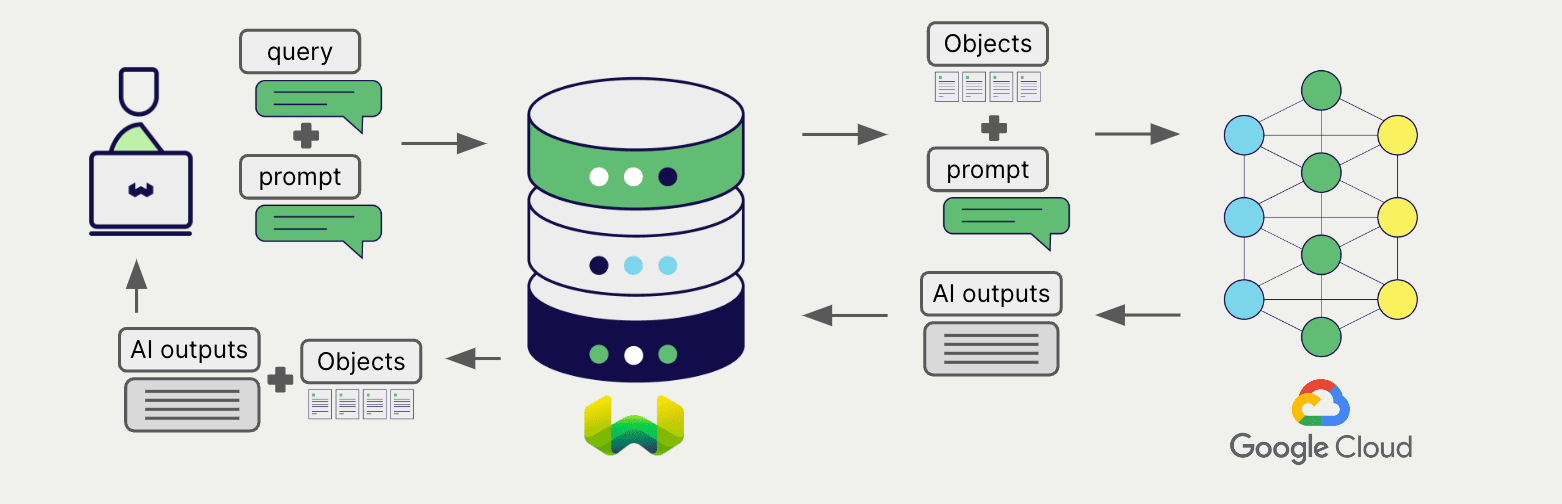
Configure a Weaviate collection to use a generative AI model with Google. Weaviate will perform retrieval augmented generation (RAG) using the specified model and your Google API key.
More specifically, Weaviate will perform a search, retrieve the most relevant objects, and then pass them to the Google generative model to generate outputs.
Requirements
Section titled “Requirements”Weaviate configuration
Section titled “Weaviate configuration”Your Weaviate instance must be configured with the Google generative AI integration (generative-google) module.
For Weaviate Cloud (WCD) users
This integration is enabled by default on Weaviate Cloud (WCD) instances.
For self-hosted users
- Check the cluster metadata to verify if the module is enabled.
- Follow the how-to configure modules guide to enable the module in Weaviate.
API credentials
Section titled “API credentials”You must provide valid API credentials to Weaviate for the appropriate integration.
Gemini API
Section titled “Gemini API”Go to Google Gemini API to sign up and obtain an API key.
Vertex AI
Section titled “Vertex AI”This is called an access token in Google Cloud.
Automatic token generation
Section titled “Automatic token generation”You can save your Google Vertex AI credentials and have Weaviate generate the necessary tokens for you. This enables use of IAM service accounts in private deployments that can hold Google credentials.
To do so:
- Set
USE_GOOGLE_AUTHenvironment variable totrue. - Have the credentials available in one of the following locations.
Once appropriate credentials are found, Weaviate uses them to generate an access token and authenticates itself against Vertex AI. Upon token expiry, Weaviate generates a replacement access token.
In a containerized environment, you can mount the credentials file to the container. For example, you can mount the credentials file to the /etc/weaviate/ directory and set the GOOGLE_APPLICATION_CREDENTIALS environment variable to /etc/weaviate/google_credentials.json.
Search locations for Google Vertex AI credentials
Once USE_GOOGLE_AUTH is set to true, Weaviate will look for credentials in the following places, preferring the first location found:
- A JSON file whose path is specified by the
GOOGLE_APPLICATION_CREDENTIALSenvironment variable. For workload identity federation, refer to this link on how to generate the JSON configuration file for on-prem/non-Google cloud platforms. - A JSON file in a location known to the
gcloudcommand-line tool. On Windows, this is%APPDATA%/gcloud/application_default_credentials.json. On other systems,$HOME/.config/gcloud/application_default_credentials.json. - On Google App Engine standard first generation runtimes (<= Go 1.9) it uses the appengine.AccessToken function.
- On Google Compute Engine, Google App Engine standard second generation runtimes (>= Go 1.11), and Google App Engine flexible environment, it fetches credentials from the metadata server.
Manual token retrieval
Section titled “Manual token retrieval”This is called an access token in Google Cloud.
If you have the Google Cloud CLI tool installed and set up, you can view your token by running the following command:
gcloud auth print-access-tokenBy default, Google Cloud's OAuth 2.0 access tokens have a lifetime of 1 hour. You can create tokens that last up to 12 hours. To create longer lasting tokens, follow the instructions in the Google Cloud IAM Guide.
Since the OAuth token is only valid for a limited time, you must periodically replace the token with a new one. After you generate the new token, you have to re-instantiate your Weaviate client to use it.
You can update the OAuth token manually, but manual updates may not be appropriate for your use case.
You can also automate the OAth token update. Weaviate does not control the OAth token update procedure. However, here are some automation options:
With Google Cloud CLI
If you are using the Google Cloud CLI, write a script to periodically update the token and extract the results.
Python code to extract the token looks like this:
client = re_instantiate_weaviate()This is the re_instantiate_weaviate function:
import subprocess
import weaviate

def refresh_token() -> str:
    result = subprocess.run(["gcloud", "auth", "print-access-token"], capture_output=True, text=True)
    if result.returncode != 0:
        print(f"Error refreshing token: {result.stderr}")
        return None
    return result.stdout.strip()

def re_instantiate_weaviate() -> weaviate.Client:
    token = refresh_token()

    client = weaviate.Client(
      url = "https://WEAVIATE_INSTANCE_URL",  # Replace WEAVIATE_INSTANCE_URL with the URL
      additional_headers = {
        "X-Goog-Vertex-Api-Key": token,
      }
    )
    return client

# Run this every ~60 minutes
client = re_instantiate_weaviate()
With google-auth
Another way is through Google's own authentication library google-auth.
See the links to google-auth in Python and Node.js libraries.
You can, then, periodically the refresh function (see Python docs) to obtain a renewed token, and re-instantiate the Weaviate client.
For example, you could periodically run:
client = re_instantiate_weaviate()Where re_instantiate_weaviate is something like:
from google.auth.transport.requests import Request
from google.oauth2.service_account import Credentials
import weaviate
import os


def get_credentials() -> Credentials:
    credentials = Credentials.from_service_account_file(
        "path/to/your/service-account.json",
        scopes=[
            "https://www.googleapis.com/auth/generative-language",
            "https://www.googleapis.com/auth/cloud-platform",
        ],
    )
    request = Request()
    credentials.refresh(request)
    return credentials


def re_instantiate_weaviate() -> weaviate.Client:
    from weaviate.classes.init import Auth

    weaviate_api_key = os.environ["WEAVIATE_API_KEY"]
    credentials = get_credentials()
    token = credentials.token

    client = weaviate.connect_to_weaviate_cloud(  # e.g. if you use the Weaviate Cloud Service
        cluster_url="https://WEAVIATE_INSTANCE_URL",  # Replace WEAVIATE_INSTANCE_URL with the URL
        auth_credentials=Auth.api_key(weaviate_api_key),  # Replace with your Weaviate Cloud key
        headers={
            "X-Goog-Vertex-Api-Key": token,
        },
    )
    return client


# Run this every ~60 minutes
client = re_instantiate_weaviate()
The service account key shown above can be generated by following this guide.
Provide the API key
Section titled “Provide the API key”Provide the API key to Weaviate at runtime, as shown in the examples below.
Note the separate headers that are available for Gemini API and Vertex AI users.
API key headers
From v1.27.7, v1.26.12 and v1.25.27, X-Goog-Vertex-Api-Key and X-Goog-Studio-Api-Key headers are supported for Vertex AI users and Gemini API respectively. We recommend these headers for highest compatibility.
Consider X-Google-Vertex-Api-Key, X-Google-Studio-Api-Key, X-Google-Api-Key and X-PaLM-Api-Key deprecated.
# Recommended: save sensitive data as environment variables
vertex_key = os.getenv("VERTEX_API_KEY")
studio_key = os.getenv("STUDIO_API_KEY")const vertexApiKey = process.env.VERTEX_API_KEY || ''; // Replace with your inference API key
const studioApiKey = process.env.STUDIO_API_KEY || ''; // Replace with your inference API keyConfigure collection
Section titled “Configure collection”Configure a Weaviate index as follows to use a Google generative AI model as follows:
Note that the required parameters differ between Vertex AI and Gemini API.
You can specify one of the available models for Weaviate to use. The default model is used if no model is specified.
Vertex AI
Section titled “Vertex AI”Vertex AI users must provide the Google Cloud project ID in the collection configuration.
from weaviate.classes.config import Configureclient.collections.create( "DemoCollection", generative_config=Configure.Generative.google( project_id="<google-cloud-project-id>", # Required for Vertex AI model_id="gemini-2.5-flash" ) # Additional parameters not shown)await client.collections.create({ name: 'DemoCollection', generative: weaviate.configure.generative.google({ projectId: '<google-cloud-project-id>', // Required for Vertex AI modelId: 'gemini-2.5-flash' }), // Additional parameters not shown});Gemini API
Section titled “Gemini API”from weaviate.classes.config import Configureclient.collections.create( "DemoCollection", generative_config=Configure.Generative.google( model_id="gemini-2.5-flash" ) # Additional parameters not shown)await client.collections.create({ name: 'DemoCollection', generative: weaviate.configure.generative.google({ modelId: 'gemini-2.5-flash', }), // Additional parameters not shown});Generative parameters
Section titled “Generative parameters”Configure the following generative parameters to customize the model behavior.
from weaviate.classes.config import Configureclient.collections.create( "DemoCollection", generative_config=Configure.Generative.google( # project_id="<google-cloud-project-id>", # Required for Vertex AI # model_id="<google-model-id>", # api_endpoint="<google-api-endpoint>", # temperature=0.7, # top_k=5, # top_p=0.9, # vectorize_collection_name=False, ) # Additional parameters not shown)await client.collections.create({ name: 'DemoCollection', generative: weaviate.configure.generative.google({ projectId: '<google-cloud-project-id>', // Required for Vertex AI modelId: '<google-model-id>', apiEndpoint: '<google-api-endpoint>', temperature: 0.7, topK: 5, topP: 0.9, }), // Additional parameters not shown});Select a model at runtime
Section titled “Select a model at runtime”Aside from setting the default model provider when creating the collection, you can also override it at query time.
from weaviate.classes.config import Configurefrom weaviate.classes.generate import GenerativeConfigcollection = client.collections.use("DemoCollection")response = collection.generate.near_text( query="A holiday film", limit=2, grouped_task="Write a tweet promoting these two movies", generative_provider=GenerativeConfig.google( # # These parameters are optional # project_id="<google-cloud-project-id>", # Required for Vertex AI # model_id="<google-model-id>", # api_endpoint="<google-api-endpoint>", # temperature=0.7, # top_k=5, # top_p=0.9, # vectorize_collection_name=False, ), # Additional parameters not shown)import { generativeParameters } from 'weaviate-client';Retrieval augmented generation
Section titled “Retrieval augmented generation”After configuring the generative AI integration, perform RAG operations, either with the single prompt or grouped task method.
Single prompt
Section titled “Single prompt”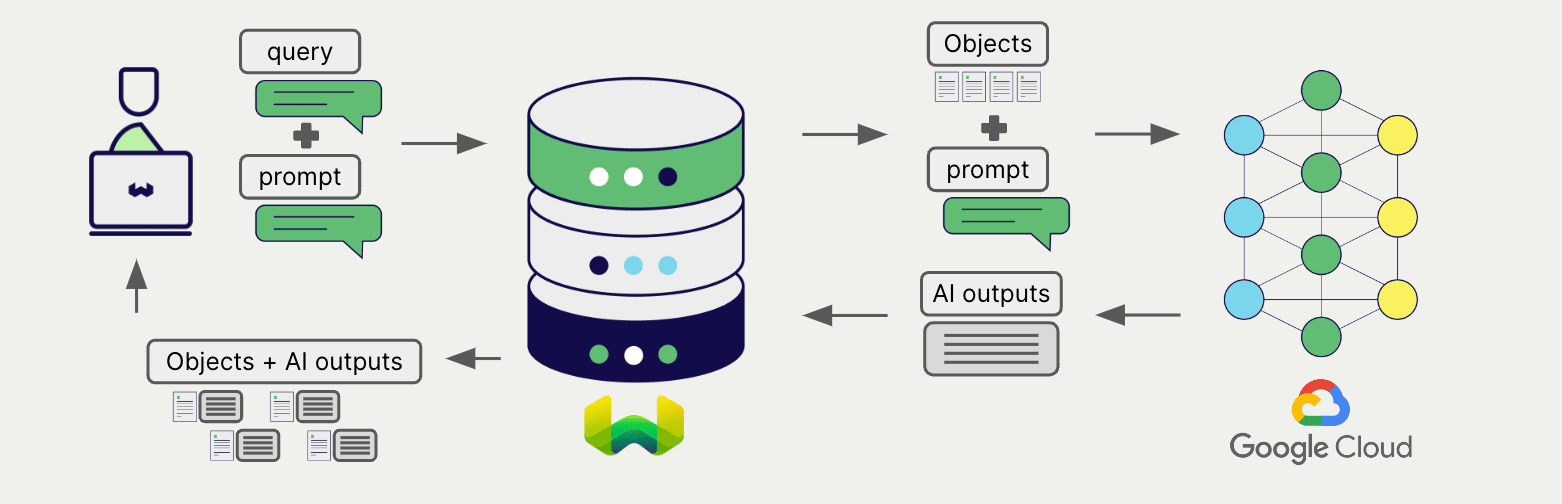
To generate text for each object in the search results, use the single prompt method.
The example below generates outputs for each of the n search results, where n is specified by the limit parameter.
When creating a single prompt query, use braces {} to interpolate the object properties you want Weaviate to pass on to the language model. For example, to pass on the object's title property, include {title} in the query.
collection = client.collections.use("DemoCollection")response = collection.generate.near_text( query="A holiday film", # The model provider integration will automatically vectorize the query single_prompt="Translate this into French: {title}", limit=2)for obj in response.objects: print(obj.properties["title"]) print(f"Generated output: {obj.generated}") # Note that the generated output is per objectlet response;
const myCollection = client.collections.use("DemoCollection");Grouped task
Section titled “Grouped task”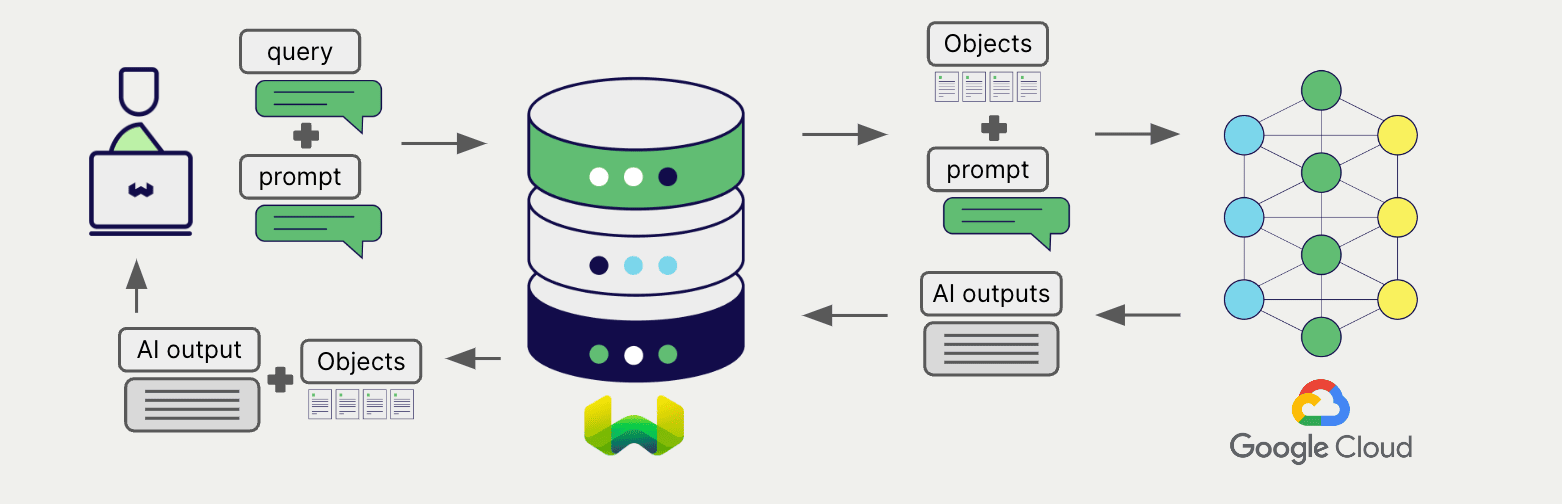
To generate one text for the entire set of search results, use the grouped task method.
In other words, when you have n search results, the generative model generates one output for the entire group.
collection = client.collections.use("DemoCollection")response = collection.generate.near_text( query="A holiday film", # The model provider integration will automatically vectorize the query grouped_task="Write a fun tweet to promote readers to check out these films.", limit=2)print(f"Generated output: {response.generative.text}") # Note that the generated output is per queryfor obj in response.objects: print(obj.properties["title"])let response;
const myCollection = client.collections.use("DemoCollection");RAG with images
Section titled “RAG with images”You can also supply images as a part of the input when performing retrieval augmented generation in both single prompts and grouped tasks.
import base64import requestsfrom weaviate.classes.generate import GenerativeConfig, GenerativeParameterssrc_img_path = "https://upload.wikimedia.org/wikipedia/commons/thumb/b/b0/Winter_forest_silver.jpg/960px-Winter_forest_silver.jpg"base64_image = base64.b64encode(requests.get(src_img_path).content).decode('utf-8')prompt = GenerativeParameters.grouped_task( prompt="Which movie is closest to the image in terms of atmosphere", images=[base64_image], # A list of base64 encoded strings of the image bytes # image_properties=["img"], # Properties containing images in Weaviate)jeopardy = client.collections.use("DemoCollection")response = jeopardy.generate.near_text( query="Movies", limit=5, grouped_task=prompt, generative_provider=GenerativeConfig.google( max_tokens=1000 ),)# Print the source property and the generated responsefor o in response.objects: print(f"Title property: {o.properties['title']}")print(f"Grouped task result: {response.generative.text}")import { generativeParameters } from 'weaviate-client';References
Section titled “References”Available models
Section titled “Available models”Vertex AI:
gemini-2.5-progemini-2.5-flashgemini-2.0-flashgemini-1.5-progemini-1.5-flash
Gemini API:
gemini-2.5-flashgemini-2.5-progemini-2.0-flashgemini-1.5-progemini-1.5-flash
Deprecated models
The following models have been deprecated by Google. They may not function as expected.
Vertex AI:
chat-bisonchat-bison-32kchat-bison@002chat-bison-32k@002chat-bison@001gemini-1.0-pro-002gemini-1.0-pro-001gemini-1.0-progemini-1.5-pro-preview-0514gemini-1.5-pro-preview-0409gemini-1.5-flash-preview-0514
Gemini API:
chat-bison-001gemini-pro
Further resources
Section titled “Further resources”Other integrations
Section titled “Other integrations”Code examples
Section titled “Code examples”Once the integrations are configured at the collection, the data management and search operations in Weaviate work identically to any other collection. See the following model-agnostic examples:
- The How-to: Manage collections and How-to: Manage objects guides show how to perform data operations (i.e. create, read, update, delete collections and objects within them).
- The How-to: Query & Search guides show how to perform search operations (i.e. vector, keyword, hybrid) as well as retrieval augmented generation.
References
Section titled “References”- Google Vertex AI
- Google Gemini API
Questions and feedback
Section titled “Questions and feedback”Have a question or feedback? Here's how to reach us.